
Join us as we go back in time to tell the stories of Griffith, from before our town was even thought of and onward.
Written by Karen Kulinski
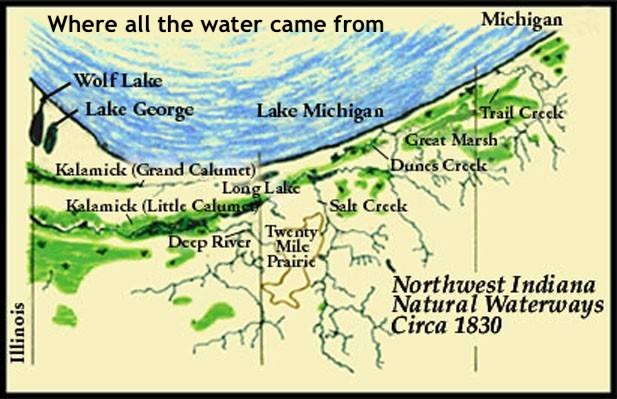
So, in our last Tale, I left you standing up to your waist in the marsh water that one day would be the site of Griffith, Indiana.
By 1850 the Native Americans had been “treaty-ed” out of Indiana, and the U.S. government decided to rid themselves of the uninhabitable marshlands they still owned at the top of our state, but had no use for.
So was passed The Swampland Act of 1850.
Our state — really, all states that bordered the Great Lakes — were given these lands to encourage settlement. The idea was for Indiana to sell the land cheap to Americans and immigrants alike at $1.25 an acre ($51.92 today.)
There was a bit of a catch, though. The land was mostly underwater, and the buyers would have to drain it before the land could be used to plant crops or build homes on. But there was an incentive, too.
It had been discovered that all that land under all that water for all that time was prime farmland once it was drained, fertile beyond belief. By 1859, the total amount of land sold in Indiana under the Swampland Act was 1,257,588 acres.
The first settlers to come to Griffith, Mathias and Anna Miller, along with Mathias’ brother, arrived in 1853 and settled on land in the area where the trains eventually crossed on Broad Street.
The Millers lived in a sand dune dugout for their first year in Indiana until Mathias and his brother drained the water off their land and could build a log dwelling.
In 1853, draining land was done by picking up a shovel and digging a ditch to hold back the water or divert it. I once put forth the question: How do you dig a ditch when the land is under water? The answer, you wait to do the digging until late summer, early fall when the water recedes and dries up.
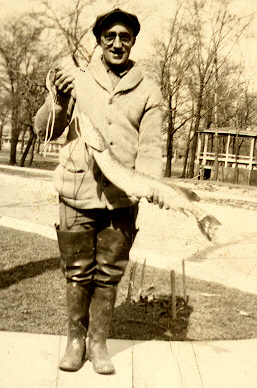
Fun Fact: some 70 years later, a descendent of Mathias and Anna — Leo Miller — caught a mighty fine fish in a Griffith ditch.
In later years, a man by the name of Noah Hart, operated a profitable business digging a massive ditch, with large teams of mules, which opened up more land for farming. Mr. Hart called his creation Cady Ditch after Jack Cady, an innkeeper in the area.
Those early farms grew crops and raised cows and pigs mainly for their own consumption rather than to sell. Among these farm families were many of German descent like Mathias and Anna Miller — the Hoffmans, the Helfens, and the Redars.
But things were destined to change for the farm folks. At the same time that settlement was beginning in Northwest Indiana, the first railroad was built on the east coast, the Baltimore and Ohio.
Some 34 years later, the first railroad line would come through what would become Griffith — the Joliet & Northern Indiana, later acquired by the Michigan Central. This rail line was heading to the big city of Chicago, Illinois. Chicago was, and is still, the railroad capital of the United States.
Toward the end of the 1800’s, three more railroads came through Griffith, and the Erie Railroad had built a depot in the area that would become Broad Street.
Those four railroads attracted the attention of two entrepreneurs from Rensselaer, Indiana, who dreamed of creating a city to rival Chicago in Northwest Indiana.
But that’s another story.
Read more 👉
Society Sagas: https://ghsinc.org/category/society-saga/
Tales of the Tower: https://ghsinc.org/category/the-tower/
Tales of the Town: https://ghsinc.org/category/tales-of-the-town/
History Notes: https://ghsinc.org/category/history-notes/

 Griffith History Museums