𝐓𝐫𝐚𝐠𝐞𝐝𝐲 𝐢𝐧 𝐭𝐡𝐞 𝐓𝐨𝐰𝐞𝐫

𝙅𝙤𝙚 𝙈𝙞𝙡𝙡𝙚𝙧’𝙨 𝙎𝙩𝙤𝙧𝙮

𝗙𝗶𝗿𝗲!

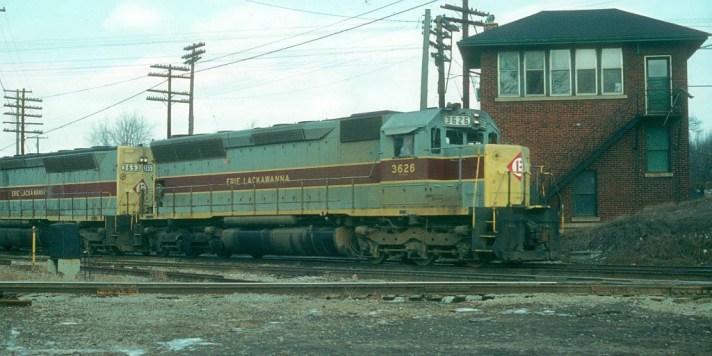
A fear that is universal to all of us, but must have run deeper for men like Joe Miller, who worked in Griffith’s 30-ft-tall Elgin Joliet and Eastern Railway interlocking tower.

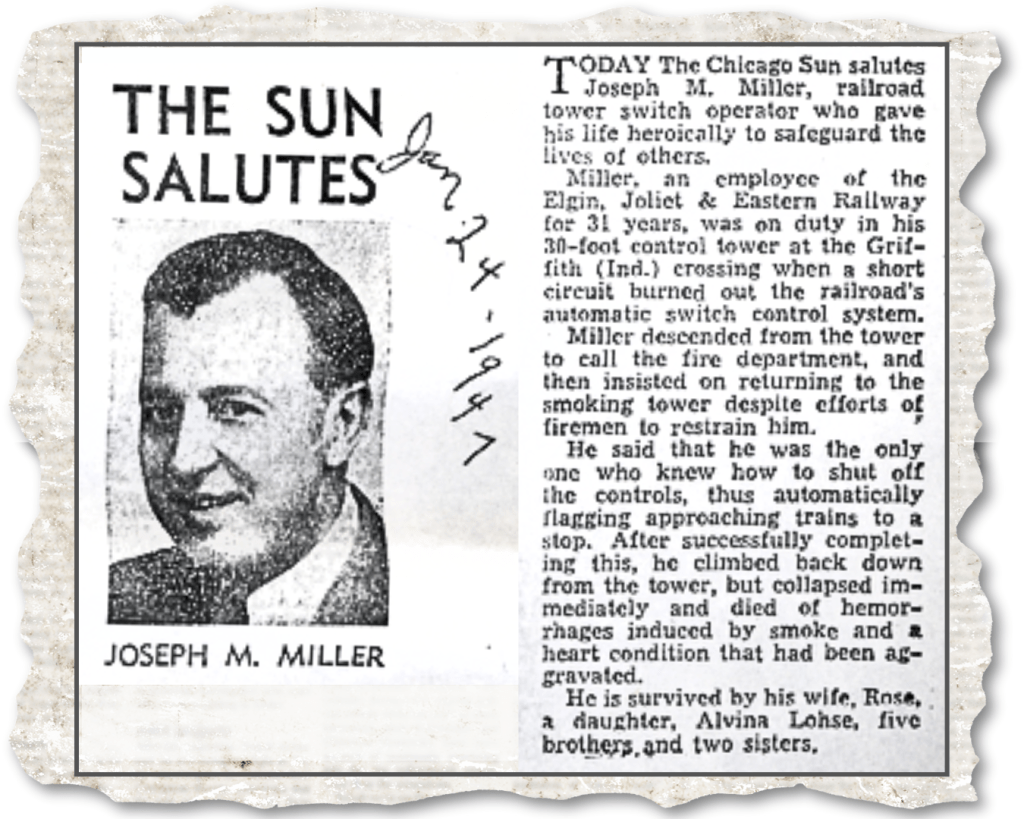
You can imagine Joe’s terror that evening in early January, 1947, when smoke began pouring from the tower’s automatic switching controls. With more than 20 years a towerman, he immediately tried to put the fire out himself.

When that failed, and with no other way to alert the nearest depot, he ran down the tower stairs, knowing he was losing time with every step.

When the firemen arrived, all volunteers, Joe returned with them to the tower room despite Fire Chief Robert McFarland’s efforts to restrain him.

“I have go up there,” he told the Chief. “I’m the only one who knows how to shut off the controls that will flag oncoming trains to stop.”
So, Joe Miller went back into the smoky tower room again and did what he had to do. He again went down that long string of stairs and was taken to the local doctor’s office.

He was coughing hard and often, and the doctor called Highland to use their Pullmotoran. But even that, an early type of ventilator to assist with breathing difficulties, didn’t help.

Sadly, the time spent in the tower room inhaling smoke and chemical fumes from burning burning electrical wires had vanquished Joe’s lungs and heart.

In the tradition of railroad men for generations, Joe Miller had done his duty, and gave his life heroically in doing so.
Newspaper articles praised his bravery and dedication to saving lives.

One newspaper ran an editorial suggesting Joe be nominated for a Carnegie Hero Award. Named after philanthropist Andrew Carnegie, it is presented “to individuals in the United States and Canada who risk death or serious physical injury to an extraordinary degree saving or attempting to save the lives of others.”

Joe Miller did not receive that award, but he did receive notice from a man that some might say was equal in fame to Mr. Carnegie.

The upper room of the Griffith Centennial Tower Museum is dedicated to Mr. Miller’s memory as the Joseph Miller Tower Room.

Come back to find out the rest of the story.
𝐎𝐧𝐜𝐞 𝐔𝐩𝐨𝐧 𝐚 𝐓𝐨𝐰𝐞𝐫 – 𝐏𝐚𝐫𝐭 𝟑

𝙊𝙪𝙧 𝙎𝙤𝙘𝙞𝙚𝙩𝙮 𝙎𝙖𝙜𝙖 – 𝙎𝙖𝙫𝙞𝙣𝙜 𝙩𝙝𝙚 𝙏𝙤𝙬𝙚𝙧
𝐇𝐞𝐥𝐩 𝐅𝐫𝐨𝐦 𝐒𝐨𝐦𝐞 𝐒𝐩𝐞𝐜𝐢𝐚𝐥 𝐅𝐫𝐢𝐞𝐧𝐝𝐬
𝘣𝘺 𝘒𝘢𝘳𝘦𝘯 𝘒𝘶𝘭𝘪𝘯𝘴𝘬𝘪

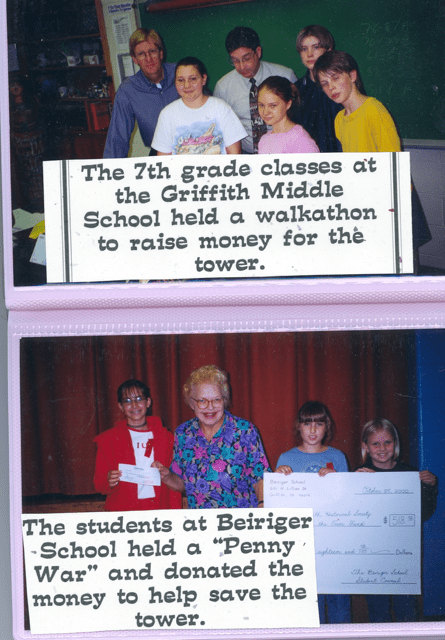
You know you’re reeeeeally in need of cash when you take money from school kids. But that’s what we did 25 years ago, and we did it twice.

To be honest, we were honored to do it. Because, in both of the cases, the students wanted to give us money for the tower and they worked to do it.

Seventh-graders, in the then Griffith Junior/Senior High School, held a walkathon from the school to our Historical Park and back, earning us more than $500. And the Beiriger Elementary School students held a Penny War for us.

Come to find out every year back then, the Beiriger Student Council voted on one project to support. In the year 2000, they chose our Griffith Tower.

“We felt saving the tower was important to the town,” said Student Council president Ashley Korak, when interviewed for a newspaper article. “With so few towers left, we want to preserve ours.”

Note: When Ashley said those words, there were 177 towers still in operation in North America. Twenty-five years later, there are fewer than 50.

The Penny War worked like this: Each grade was given a big jar into which students deposited pennies into their particular jars every day for a week. All the jars were kept in the school foyer, and at the end of the week, a total $518.72 from all the jars was given to the tower.

The 5th graders donated the most pennies, with the 6th grade coming in 2nd place, and the 3rd graders taking 3rd.

Griffith Historical Society President Delores Smessaert, in the photo here, thanks all the students. “So much work needs to be done in this 76-year-old building,” she went on, “and your donation will go a long way in helping us install a new heating system.”

WHAT IS AN INTERLOCKING TOWER, ANYWAY?

There is a truth beyond doubting that railroad companies really don’t like when two trains collide. Especially in bygone times when they were just getting started and money was tight.

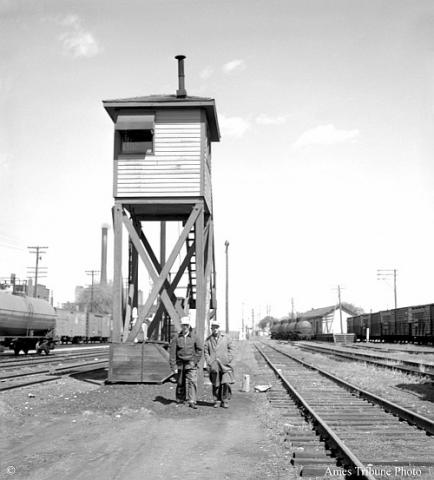
So, wherever two sets of rail lines crossed each other, known as an interlocking, a small cabin on stilts was built to control train movement. It was up high to provide a clear view of the tracks. An employee would manually activate the grade crossing signals and gates before automatic detection was available or installed.  (Check out the photos below!)

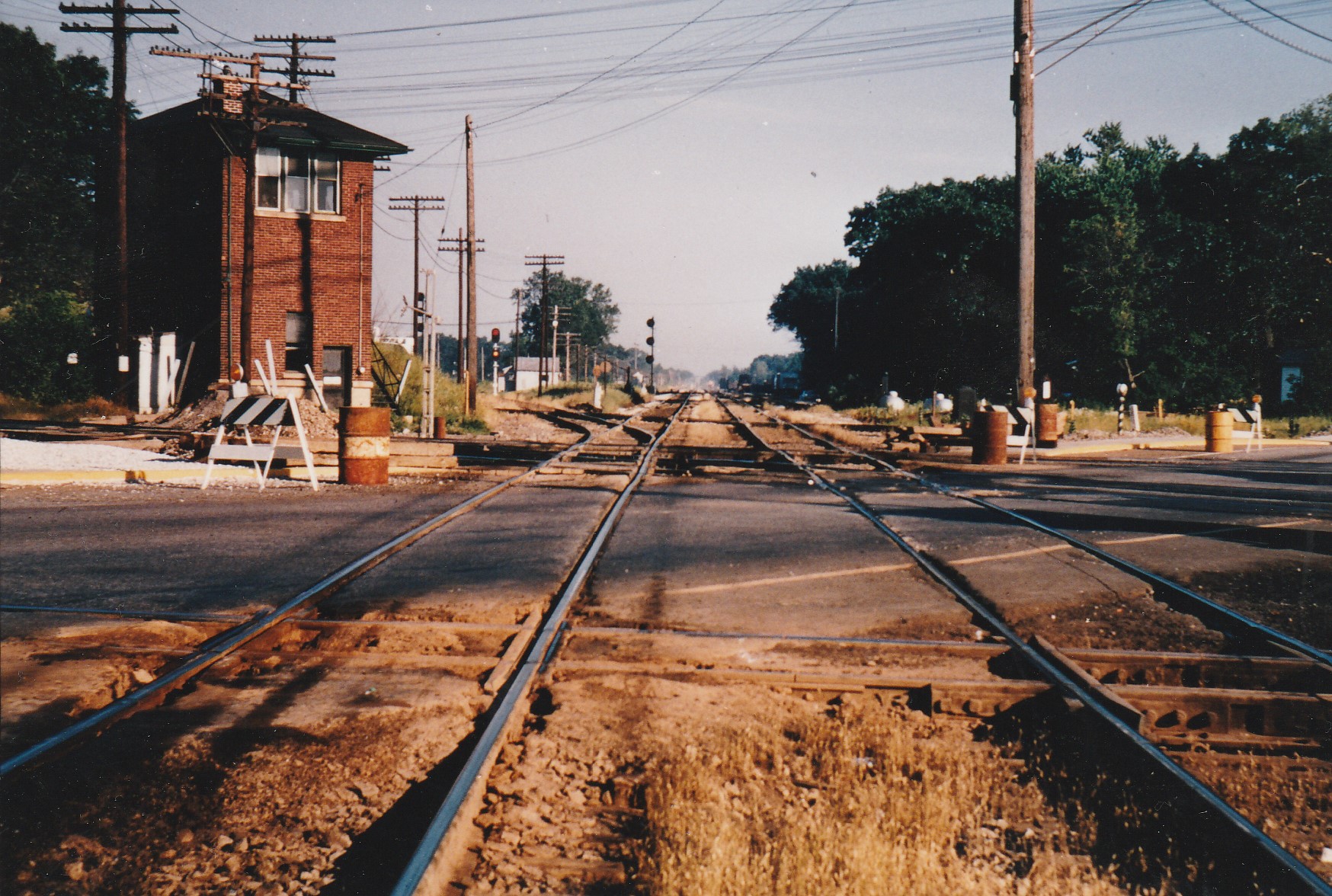
Griffith’s junction had five sets of rail lines interlocking at one place, hence the need for a larger brick building.

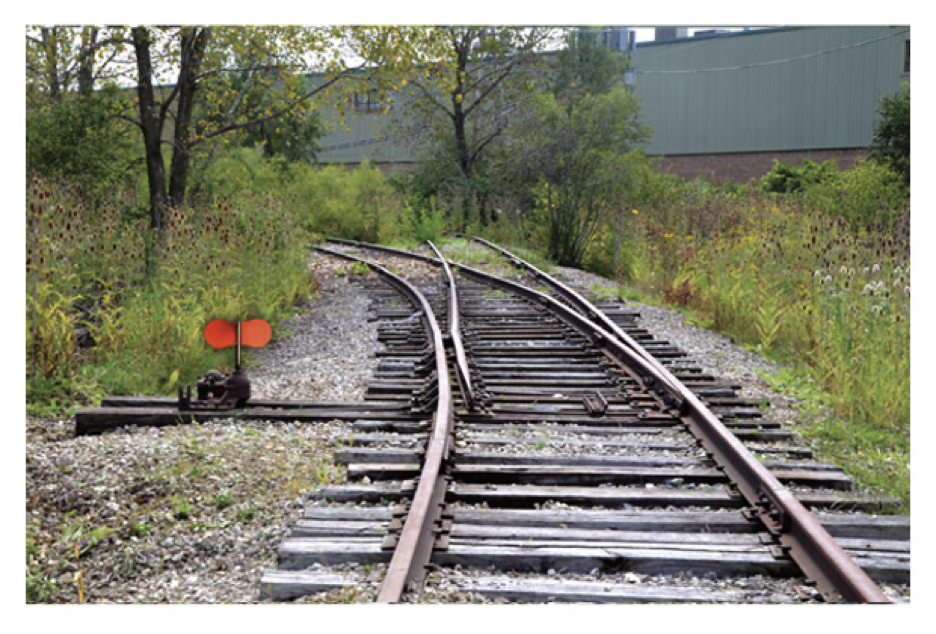
An interlocking tower was outfitted with machinery that linked the tower to sets of moveable tracks, called “switch tracks,” and a man that operated it. Through the use of levers linked to these tracks, the Operator, often called the Towerman, could control their position.

By carefully coordinating these switch tracks, the Operator was able to ensure an oncoming train was safely guided onto the right track to avoid a collision.

At one time, there were 5,000 railroad towers, in North America. Today, there are fewer than 50 towers still operating. Most of the rest have been torn down due to advancements in technology.

Our tower also faced demolition 25 years ago, but then Elgin Joliet & Eastern Railway general manager, Mel Turner, asked if we wanted the building. Of course, we said, “YES!”

We’ll continue to unfold more of this story here on our site, culminating in a Celebrate Our Tower Day, at the Griffith Historical Park, August 10th.  

So, be sure to stay tuned, to use a well-known phrase of days gone by.

(And click the DONATE button now to help support upkeep of the Tower and rail-cam!!)

Left: Ames, IA Gate Tower, April 4, 1958 , which looks similar to a manually operated switch tower ; Web source: https://ameshistory.org/tribunearchives/railroad-crossing-watchmen
Right Top: Switch rails; Right bottom:
Griffith’s Interlocking Tower,
July 6, 1974, Photo taken by John Strombeck
Web source: https://industrialscenery.blogspot.com/2017/09/griffith-in-ej-and-cngtw-junction-tower.html

𝐎𝐧𝐜𝐞 𝐔𝐩𝐨𝐧 𝐚 𝐓𝐨𝐰𝐞𝐫 – 𝐏𝐚𝐫𝐭 𝟏

𝙊𝙪𝙧 𝙎𝙤𝙘𝙞𝙚𝙩𝙮 𝙎𝙖𝙜𝙖 – 𝙎𝙖𝙫𝙞𝙣𝙜 𝙩𝙝𝙚 𝙏𝙤𝙬𝙚𝙧
𝘣𝘺 𝘒𝘢𝘳𝘦𝘯 𝘒𝘶𝘭𝘪𝘯𝘴𝘬𝘪

The tale of the Tower, and indeed a great deal of Griffith Historical Society’s history, reads like a storybook, hence the title.

Do you know what 𝙨𝙚𝙧𝙚𝙣𝙙𝙞𝙥𝙞𝙩𝙮 is? Beyond an amazing Griffith ice cream parlor? I use the world a lot when talking about how we developed and grew.

Serendipity in the dictionary is described as: 𝗮 𝗰𝗵𝗮𝗻𝗰𝗲 𝗼𝗰𝗰𝘂𝗿𝗿𝗲𝗻𝗰𝗲 𝘁𝗵𝗮𝘁 𝗱𝗲𝘃𝗲𝗹𝗼𝗽𝘀 𝗶𝗻 𝗮 𝗵𝗮𝗽𝗽𝘆 𝗼𝗿 𝗯𝗲𝗻𝗲𝗳𝗶𝗰𝗶𝗮𝗹 𝘄𝗮𝘆.

Serendipity in real life:

  • The chance meeting of four people who went on to spearhead the saving of the last Griffith’s depot from demolition. (See our first “Society Saga” in our spring newsletter or on our website for that story.)
  • The time the land we hoped to expand on, that was $20,000 when we first asked to purchase it, dropping to $8,000 when we absolutely, positively, 100% had to purchase it.
  • And we must mention how I was serendipitously connected to the General Superintendent of the Elgin Joliet & Eastern railroad when I called asking for key chains and paper engineer hat to give away to kids.

That man, Mel Turner, ended up giving us the Tower some five years later.

You know how you immediately click with someone? That was me and Mr T (though I never called him that to his face).

We talked for nearly an hour: about our getting the land and our future plans for it; about his railroad’s plans for tearing down our Tower, and could we have the equipment in the upper room, which was a yes.

From time to time, I would write him, filling him in on everything we were doing, and asking about the Tower. I found those old letters recently, and it was as though I was writing to a friend. I can only help wondering what he thought of my rambles.
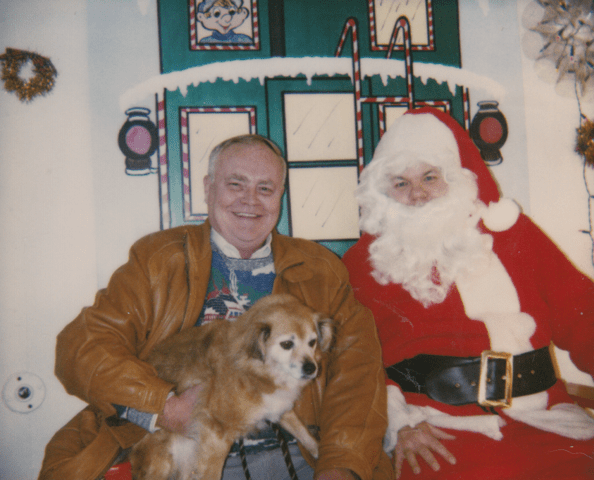
In mid-December, 1999, Mr. Turner came out to the Park during our Santa event, with his beloved dog, Buddy. Our Tower, he told us, was being closed down at the end of the year. And, he said, he was giving us the Tower!

The whole building!! And $30,000, to help with the move!!!

And we had until July 30th to get the Tower off their land.

Tale to be continued…

Mr. Turner and Santa in the Caboose

Mr. Turner and Santa in the Caboose